
Laser Refractive Surgery
Refractive surgery corrects your refractive error and reduces or eliminates dependence on glasses and contact lenses. Choosing the right technique depends on your cornea, prescription, and age.
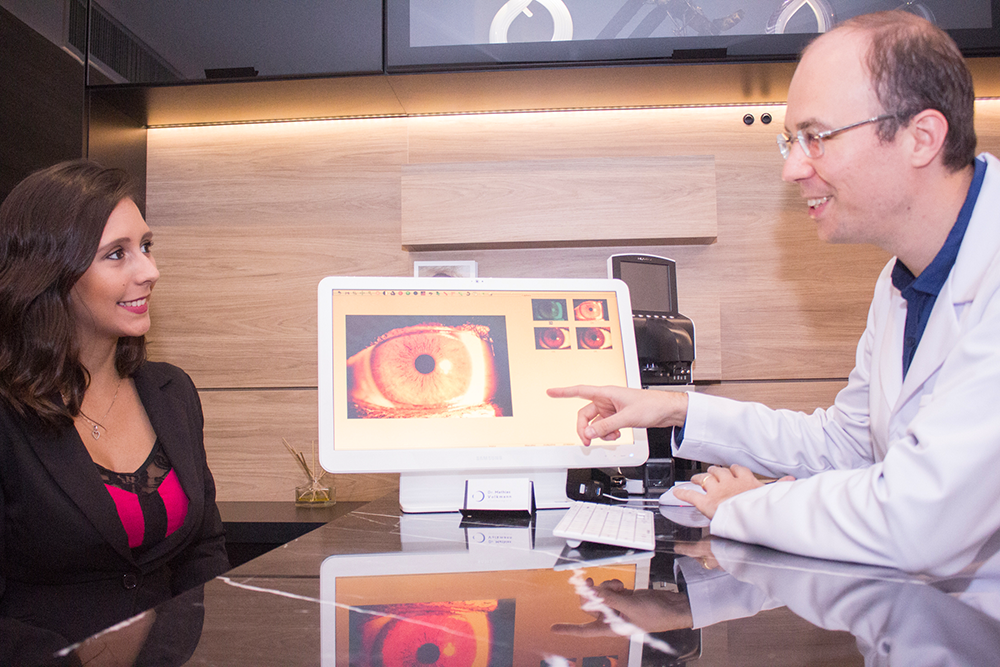
Laser Refractive Surgery (PRK with Mitomycin and LASIK)
The excimer laser reshapes the curvature of the cornea—the transparent front surface of the eye—so that light focuses accurately on the retina. The two main techniques are PRK, in which the laser is applied directly to the corneal surface, and LASIK, in which a thin corneal flap is created prior to laser application. The procedure takes only a few minutes per eye under topical anesthetic eye drops.
Why PRK with mitomycin is my preferred technique: In addition to preserving more corneal tissue, with PRK the eye remains less dry in the long term than with LASIK. Combining PRK with mitomycin provides a lower risk both during the surgical act and in the long term, which amply outweighs the slightly slower visual recovery and discomfort during the first few days after surgery.
Myopia (Nearsightedness)
In myopia, the image forms in front of the retina, making distant objects blurry. The laser flattens the central cornea. Myopic patients also benefit from thorough peripheral retinal examination to detect weak areas that could predispose to retinal detachment.
Hyperopia (Farsightedness)
In hyperopia, the image forms behind the retina, requiring extra focusing effort, especially for near tasks. The laser steepens the central corneal curvature within safe anatomical parameters.
Astigmatism
In astigmatism, the cornea has different curvatures along different meridians, causing distortion at any distance. The laser regularizes these curvatures and can be combined with myopia or hyperopia correction.
Corneal Tomography Evaluation
Surgical safety begins with comprehensive diagnostic testing. Corneal tomography maps corneal thickness as well as the anterior and posterior surfaces to rule out early signs of keratoconus or ectasia, conditions in which laser ablation is contraindicated. The evaluation also includes manifest and cycloplegic refraction, pupillometry, tear film assessment, and retinal mapping.
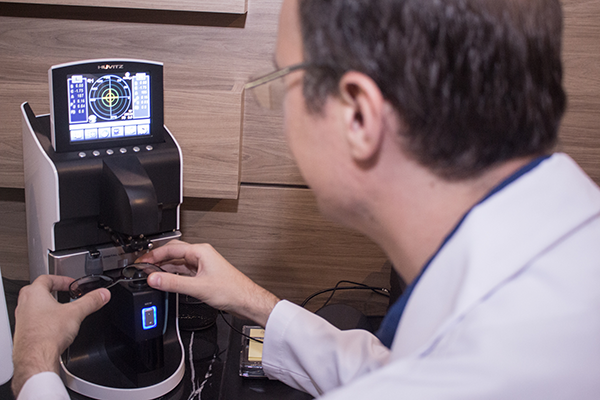
Corneal Laser vs. Intraocular Lens After Age 45–50
After age 45 to 50, presbyopia becomes part of surgical planning. Corneal laser corrects distance vision but does not restore near accommodation, and the natural lens will eventually develop cataract over time. In this age group, lens replacement with a premium intraocular lens is often a more comprehensive solution.
Learn more on our Cataract Surgery & Premium Lenses page →
Frequently Asked Questions
What is the minimum age for refractive surgery?
Generally starting at age 18, provided the eyeglass prescription has been stable for at least one year.
Why is PRK with mitomycin the preferred technique?
Because PRK with mitomycin avoids creating a corneal flap, offering lower risk both during the surgical procedure and in the long term, while leaving the eye less dry in the long term compared to LASIK. This superior safety profile outweighs the slightly slower recovery and initial discomfort in the first few days.
Can my prescription return after laser surgery?
Minor regression can occur, especially in higher prescriptions, and an enhancement can be considered when indicated. Presbyopia, which naturally appears after age 40, is a separate aging process of the internal lens and does not mean your distance prescription returned.
Can patients with thin corneas have laser surgery?
It depends on corneal thickness and tomography maps. In many cases, PRK is the safest option; in others, corneal laser is contraindicated and intraocular lenses are evaluated as alternatives.
How long should I stop wearing contact lenses before the exams?
Typically one to three weeks, depending on the type of contact lens, so the cornea returns to its natural shape and measurements are completely reliable.