
Retina & Intravitreal Injections
Intravitreal injections have transformed the prognosis of major macular diseases. With early diagnosis and regular follow-up, it is possible to stabilize and often recover a significant portion of vision.
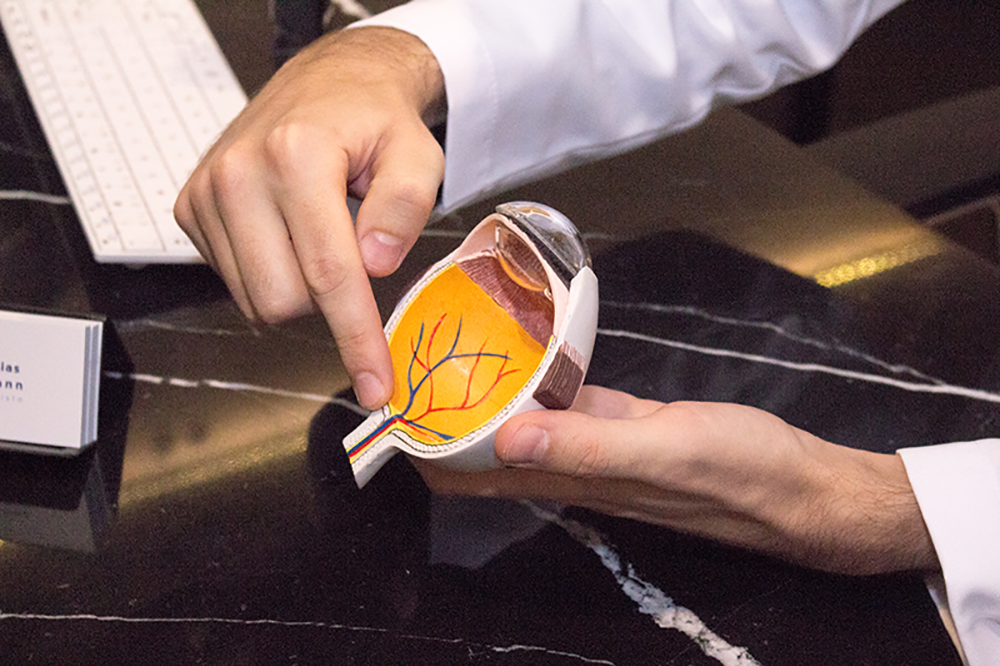
What Are Intravitreal Injections?
An intravitreal injection delivers medication directly into the vitreous cavity inside the eye, allowing it to act directly on the retina in optimal concentration with minimal systemic exposure. The procedure is performed under sterile conditions using anesthetic eye drops and strict antisepsis, lasting only a few seconds. The patient goes home shortly afterward.
Step-by-Step Application Process
- • Verification of the eye to be treated and visual acuity check.
- • Topical anesthesia with eye drops and thorough cleaning of the eyelids and ocular surface with antiseptic.
- • Placement of a small, gentle speculum to keep the eyelids open safely.
- • Delivery of the medication through a micro-fine needle into the white part of the eye (sclera) in just a few seconds.
- • Post-procedure vision check and instructions regarding eye drops and warning signs.
The entire preparation and procedure take about 15 minutes, with most of that time dedicated to preparation and antisepsis.
Medications Used
Anti-VEGF Agents
VEGF is a protein that stimulates abnormal blood vessel growth and fluid leakage in the retina. Anti-VEGF medications block this protein, drying the macula and controlling disease progression. Several agents are available with different durations of action, selected according to diagnosis, prior response, and insurance coverage.
Sustained-Release Corticosteroid Implants
Sustained-release corticosteroid implants act over several months and provide potent anti-inflammatory action. They are indicated in selected cases of macular edema—especially when response to anti-VEGF is incomplete, in pseudophakic patients (who have already had cataract surgery), or when reducing injection frequency is desirable. Requires intraocular pressure monitoring.
Conditions Treated
Age-Related Macular Degeneration (AMD) →
In wet (neovascular) AMD, abnormal blood vessels grow beneath the retina, causing distortion and central vision loss. Anti-VEGF therapy is the gold standard and should be started promptly.
Diabetic Retinopathy →
In diabetic retinopathy, injections treat diabetic macular edema—the leading cause of vision loss in patients with diabetes—and help control proliferative stages alongside retinal laser therapy.
Retinal Vein Occlusions (CRVO / BRVO) →
In central and branch retinal vein occlusions, macular edema is treated with anti-VEGF agents or corticosteroid implants while systemic cardiovascular risk factors are investigated in parallel.
OCT-Guided Follow-Up ("Treat and Extend")
Optical Coherence Tomography (OCT) is performed at follow-up visits and reveals, with micrometer precision, whether fluid remains in the retina. Using this information, injection intervals are personalized under the "treat and extend" protocol: when the retina is dry, intervals are gradually extended; if fluid recurs, intervals are shortened. This ensures each patient receives the exact number of treatments needed.
Fellowship in Retina and Vitreous at Hospital de Olhos do Paraná, with an international Observership at Moorfields Eye Hospital in London.
Frequently Asked Questions
Does an eye injection hurt?
Most patients report only a mild sensation of pressure. The eye is numbed with anesthetic eye drops, and the application itself takes just a few seconds.
How many injections will I need?
It depends on the condition and how each eye responds. Treatment generally starts with monthly loading doses, and intervals are then customized based on OCT results.
What precautions should I take after the injection?
Use the prescribed eye drops, avoid rubbing the eye, and stay out of swimming pools or the ocean for a few days. Severe pain, increasing redness, or decreased vision should be reported immediately.
Can I return to work the next day?
Yes, in most cases. It is common to notice a small red spot on the white part of the eye where the injection was given, which fades within a few days.
Do intravitreal injections cure the disease?
They control disease activity and preserve or improve vision. Conditions such as wet AMD and diabetic macular edema are chronic and require ongoing monitoring.